

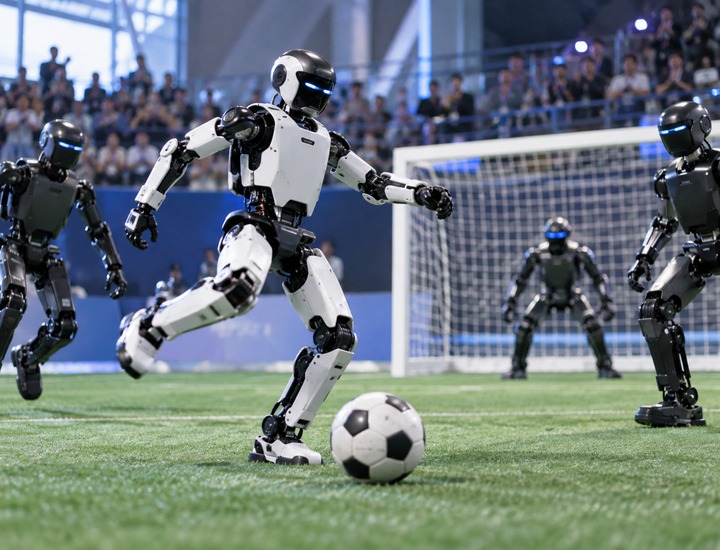
Key Takeaways
- Researchers developed a simulation-trained vision system that allows humanoid robots to chase and kick balls using onboard sensors.
- “The resulting controller produces coordinated soccer behaviors using only onboard vision, including ball searching, chasing, and multidirectional kicking,” according to the study.
- The Tsinghua Hephaestus team secured titles at both the 2025 RoboCup Adult-Size Humanoid League and the 2025 World Humanoid Robot Games, scoring 76 goals and conceding 11.
Virtual simulations power agile movements for humanoid soccer players
Humanoid robotics has frequently grappled with clumsy movement, stumbling, and unexpected freezes when machines attempt to navigate physical surroundings. Looking to address these coordination challenges, a research team led by Yushi Wang at Tsinghua University turned to the dynamic environment of soccer to design a more responsive control architecture.
Playing soccer requires machines to balance multiple demanding tasks simultaneously, from keeping their footing on varied surfaces to adjusting strides and tracking a ball with onboard cameras. Rather than relying on trial-and-error adjustments on physical hardware, the engineers designed a unified control system inside a virtual simulation. During training, the simulation intentionally introduced visual errors, sensor delays, and moments where the ball temporarily disappeared, prompting the system to estimate where the object would be and maintain momentum.
Comparison table
| Entry | Value |
|---|---|
| PausePlay% buffered00 | 00 |
| 00 | 05 |
| PausePlay% buffered00 | 00 |
| 05 | 10 |
Instead of forcing the robot to process heavy raw visual data, the onboard software translates information about the ball and playing field into concise coordinates. The scientists transferred this control protocol directly into an unmodified Booster T1 humanoid robot. As the team detailed in a paper published in Science Robotics, “The resulting controller produces coordinated soccer behaviors using only onboard vision, including ball searching, chasing, and multidirectional kicking.”
Championship victories and real-world trials
Physical evaluations demonstrated marked performance improvements. From locations in the front half of the field, the robot directed the ball into the net between 80% and 90% of the time across trials. Testing on varied terrains, such as grass, asphalt, rubber, and soil, showed resilient balance. Furthermore, the approach reduced the duration required to reach and kick the ball by up to 64% when compared against a state-of-the-art rule-based system.
The system was put to the test in high-stakes environments during international robotics tournaments in 2025. Competing as the Tsinghua Hephaestus team, the researchers won the RoboCup Adult-Size Humanoid League using the new controller. The squad went on to claim first place at the 2025 World Humanoid Robot Games as well, collectively scoring 76 goals while conceding only 11 across both events.
While the accomplishments demonstrate significant progress in physical agility and reactive planning, the developers note that further steps are necessary before humanoids can participate in fully realized team matches. The authors explained, “The policy’s observations are currently limited to the ball and goal, without incorporating information about other agents in the environment.” Future developments will focus on enabling the robots to recognize and adapt to both teammates and opposing players in real time.


