

Key Takeaways
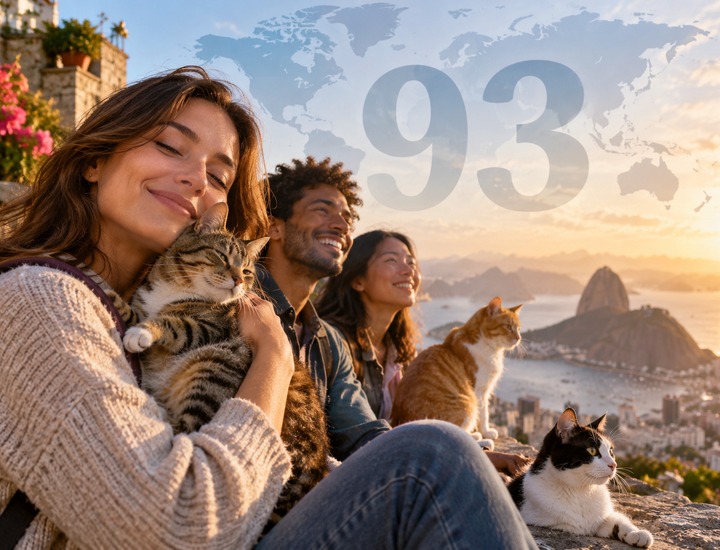
- A study examining 93 countries found that higher domestic cat density correlates with greater national happiness scores.
- Higher exposure to the parasite Toxoplasma gondii corresponded with lower happiness, but higher cat density was inversely associated with parasite prevalence.
- The authors stated, “What we found is that countries with more cats tended to report higher levels of happiness, while countries with higher exposure to Toxoplasma gondii tended to report lower levels of happiness.”
New research connects feline companionship and health to global well-being
A global study examining life satisfaction has revealed an unexpected connection between companion animals and well-being. Researchers led by Javier I. Borráz-León of the Secretariat of Science, Humanities, Technology, and Innovation in Mexico City investigated factors influencing national happiness across 93 nations. Their findings, published on September 30, 2026, show that higher domestic cat density correlates positively with national happiness scores.
While economic measures such as gross domestic product, household earnings, and healthcare expenditures have long served as primary predictors of national well-being, the team sought to explore biological and ecological interactions. By analyzing international data alongside rates of the feline-borne parasite Toxoplasma gondii, the scientists observed that biological factors operate alongside standard financial indicators in surprising ways.
Surprising patterns in feline density and health
Although cats can transmit Toxoplasma gondii to humans, countries reporting higher cat densities did not experience elevated rates of the parasite. In fact, areas with higher rates of exposure to the parasite reported lower overall happiness scores, creating an inverse pattern.
Addressing the complex findings, the study authors explained, “What we found is that countries with more cats tended to report higher levels of happiness, while countries with higher exposure to Toxoplasma gondii tended to report lower levels of happiness. Of course, these are associations at the country level, so we cannot say that having more cats makes people happier or that Toxoplasma makes people less happy, but the patterns are interesting enough to deserve further investigation.”
Looking beyond traditional socioeconomic indicators
The research group pointed out that these findings reflect broad national associations rather than direct individual causes. A country with greater economic resources and robust public healthcare systems may foster higher pet ownership while maintaining lower rates of parasitic infection.
As the authors noted, “What we find most interesting is that these results bring together factors that are usually studied separately: wealth, health, human–animal relationships and infectious disease. Our study suggests that understanding why some populations report greater well-being may require us to consider biological and ecological factors alongside the socioeconomic conditions that have traditionally received most attention.”
The unexpected divergence between cat populations and parasite spread highlights the vital role of environmental context in human-animal interactions. The authors emphasized, “One of the most surprising findings was that countries with more cats did not show greater exposure to Toxoplasma gondii; in fact, the association went in the opposite direction. This highlights an important point: the relationship between humans, animals and infectious diseases depends not simply on the presence of animals, but also on the social, economic and environmental conditions in which those interactions occur.”


