

Key Takeaways
-
Researchers have successfully used amplified quantum vacuum fluctuations to strengthen the superconducting properties of the material NbSe2.
-
Placing the superconductor in a specially designed dark cavity increased its critical temperature by up to 5.4 percent.
-
The findings suggest that empty space can be actively engineered to control and enhance macroscopic quantum states without direct external energy.
Harnessing empty space
An international team of researchers has demonstrated that quantum fluctuations within a vacuum can enhance superconductivity, offering a new method for managing unusual states of matter. Led by scientists at the University of Science and Technology of China and the Chinese Academy of Sciences, the study proves that empty space is anything but empty.
According to quantum physics principles, a vacuum contains an ever-present background of quantum fluctuations due to virtual particles continuously appearing and disappearing. While these fluctuations are known to produce observable effects like the Casimir effect, applying them to control macroscopic quantum states has remained a major question.
Reshaping the electromagnetic environment
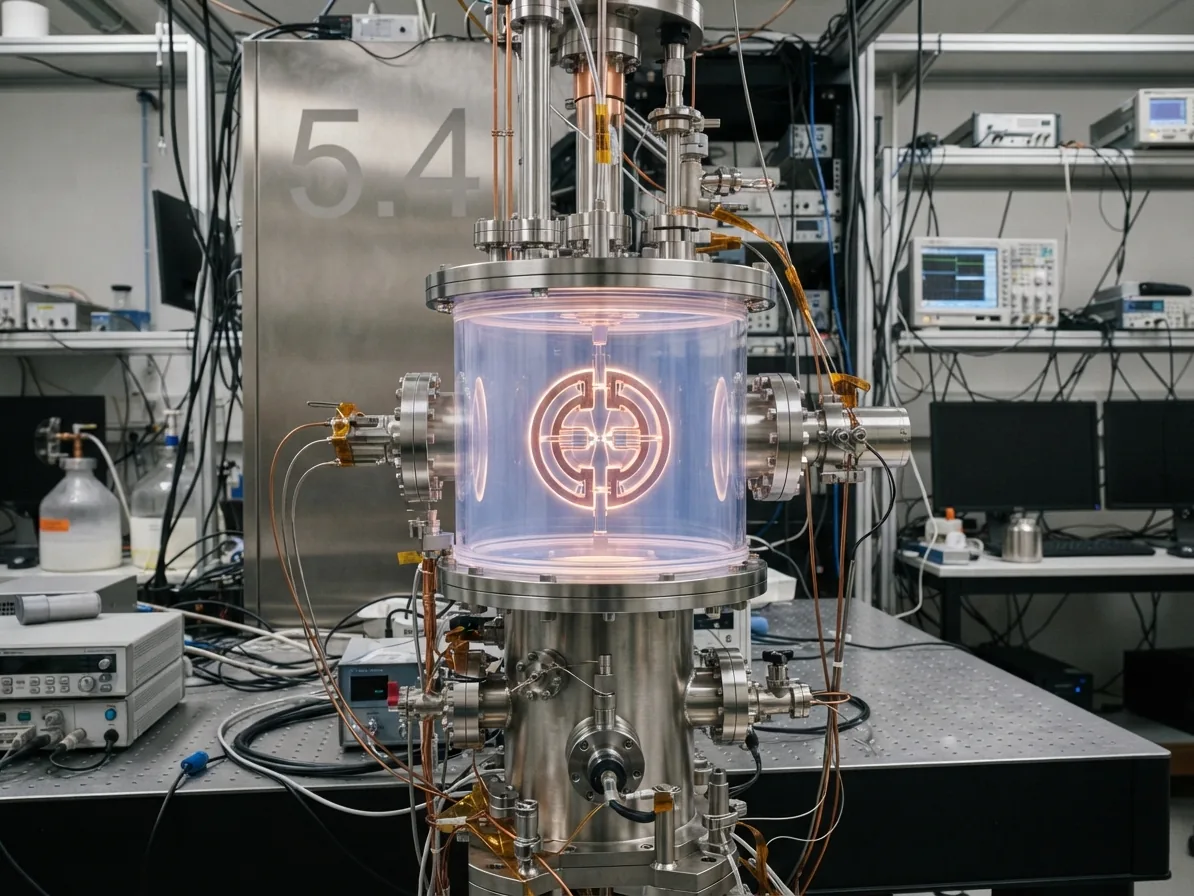
The research team, which included experts from Shanghai Jiao Tong University and the Massachusetts Institute of Technology, used a terahertz split-ring resonator to create a dark cavity. This setup was designed to reshape the electromagnetic environment and amplify the normally weak vacuum fluctuations.
“Vacuum fluctuations in free space are generally too weak to produce observable effects in macroscopic condensed-matter systems,” Prof. Changgan Zeng explained. “To overcome this limitation, we introduced a terahertz split-ring resonator. Such a dark cavity can reshape the electromagnetic environment and substantially amplify vacuum fluctuations.”
By placing the superconductor NbSe2 inside this specially engineered cavity, the researchers observed a notable improvement in its properties. The coupled system allowed the superconducting material to interact with the enhanced electromagnetic environment, resulting in a stronger superconducting state.
Significant gains in critical temperature
When the team compared the behavior of NbSe2 inside and outside the cavity, they found that the critical temperature—the point at which the material enters its superconducting state—had increased.
“We observed that the critical temperature can increase by up to 5.4% in a six-layer NbSe2 device, while the critical current and critical magnetic field are significantly enhanced near the superconducting transition,” Prof. Guanghui Cheng noted. “This represents the first experimental observation of vacuum-fluctuation-enhanced superconductivity.”
Control experiments ruled out conventional explanations such as strain or material degradation. Instead, the enhancement showed a resonance-like peak at a specific frequency, pointing directly to the coupling between the superconducting state and the dark cavity modes.
A new role for the quantum vacuum
Theoretical modeling suggests that the superconducting state exchanges virtual photons with the dark cavity, lowering energy and stabilizing superconductivity.
“When the characteristic energy of the cavity mode matched the low-energy superconducting fluctuations, the NbSe2 device exhibited resonant enhancement, producing the peak in superconductivity enhancement,” said Prof. Qingdong Jiang.
This breakthrough shifts the perspective on vacuums from passive backgrounds to active components that can be engineered to influence matter.
“In most practical physics, the vacuum serves merely as the passive stage on which phenomena play out. This work shows that the background itself can become an actor — engineered to strengthen superconductivity and reshape the behavior of quantum matter,” Prof. Frank Wilczek concluded.
The noncontact method of strengthening superconductivity without external energy sources opens up exciting possibilities for controlling quantum states in future materials science applications.


