

Key Takeaways
-
Farmers and scientists are burying cotton underwear to easily measure soil health, as active microbes will quickly decompose the fabric.
-
An Ontario farmer successfully revitalized his soil over a decade using crop rotation and grazing sheep, proving his success with a repeat underwear test.
-
A widespread Swiss citizen science study found that private gardens boast the most active soil microbes, leading researchers to propose a global "Underpants Index."
A quirky method for measuring soil health
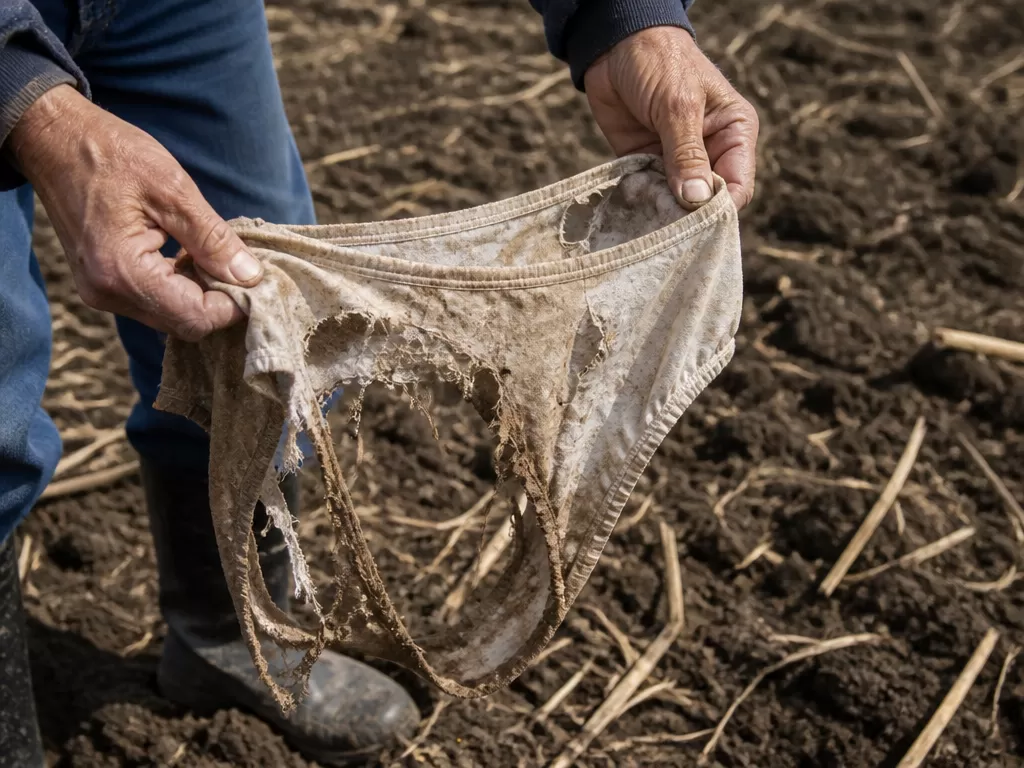
In 2015, Ontario farmer Norm Lamothe heard about a unique campaign designed to test soil health: burying a pair of white cotton underwear. The premise was simple. Healthy soil is teeming with billions of microbes that will consume organic matter like cotton. Thus, the dirtier and more degraded the dug-up undergarments, the healthier the soil.
When Lamothe first excavated his buried garments after several months, he was disappointed to find them almost completely intact, indicating poor microbial activity. This realization sparked a decade-long journey of soil rehabilitation. By implementing diverse crop rotations—including corn, soybeans, winter wheat, oats, and hay—and introducing a flock of sheep to graze and fertilize the land, he transformed his farm’s ecosystem. Ten years later, a repeat of the underwear experiment yielded heavily tattered results, proving his regenerative practices had successfully revitalized the soil.
The unconventional testing method has since taken root on a global scale. In Switzerland, a citizen science project dubbed “Proof by Underpants” mobilized 1,000 volunteers to bury more than 2,000 pairs of cotton underwear and 12,000 tea bags across nearly 1,000 different sites. Led by researchers at Agroscope and the University of Zurich, the initiative aimed to gather expansive data on soil quality while providing participants with personalized feedback on sustainable land management.
When the findings were recently published, researchers noted that private gardens exhibited the fastest decomposition rates, while standard lawns had the slowest. Agricultural fields ranked somewhere in the middle. The study’s co-leader emphasized that biologically active soil is critical for nutrient cycling and fertility. Ultimately, the researchers proposed an official “Underpants Index,” championing the quirky experiment as a highly accessible and engaging way to raise public awareness about the vital importance of soil conservation.


