

Key Takeaways
- Researchers developed a three-hour chemical method to upcycle rigid PVC plastic into polyalphaolefin, a key ingredient for synthetic engine oil.
- The reaction heats dissolved PVC, aluminum trichloride, and alpha-olefins to 158 degrees Fahrenheit, breaking down long polymer chains into useful lubricant segments.
- Collaborators from Texas A&M, Caltech, and Virginia Tech evaluated the oil’s performance, underlying chemistry, and economic manufacturing feasibility.
Turning discarded PVC into high-performance industrial oil
Items such as old plumbing pipes, discarded window frames, and expired credit cards could soon gain new life beyond the landfill. A research team led by chemist and chemical engineer Guoliang “Greg” Liu at Virginia Tech has established a chemical method that transforms polyvinyl chloride, commonly known as PVC, into polyalphaolefin. This substance serves as a critical base component in high-performance synthetic engine oils.
PVC represents one of the world’s most stubborn plastics to recycle because of its chlorine content and numerous manufacturing additives, which alter rigidity, flexibility, and heat tolerance. While conventional recycling often falters under these complex chemical additions, the newly devised procedure turns the discarded material into a valuable industrial product in roughly three hours.
“Number one, we have proved that it is feasible to use plastic waste to make high-performance lubricants. Number two, these lubricants are green, and they can meet the emerging needs for sustainability by the market,” Liu said.
The chemical process behind the transformation
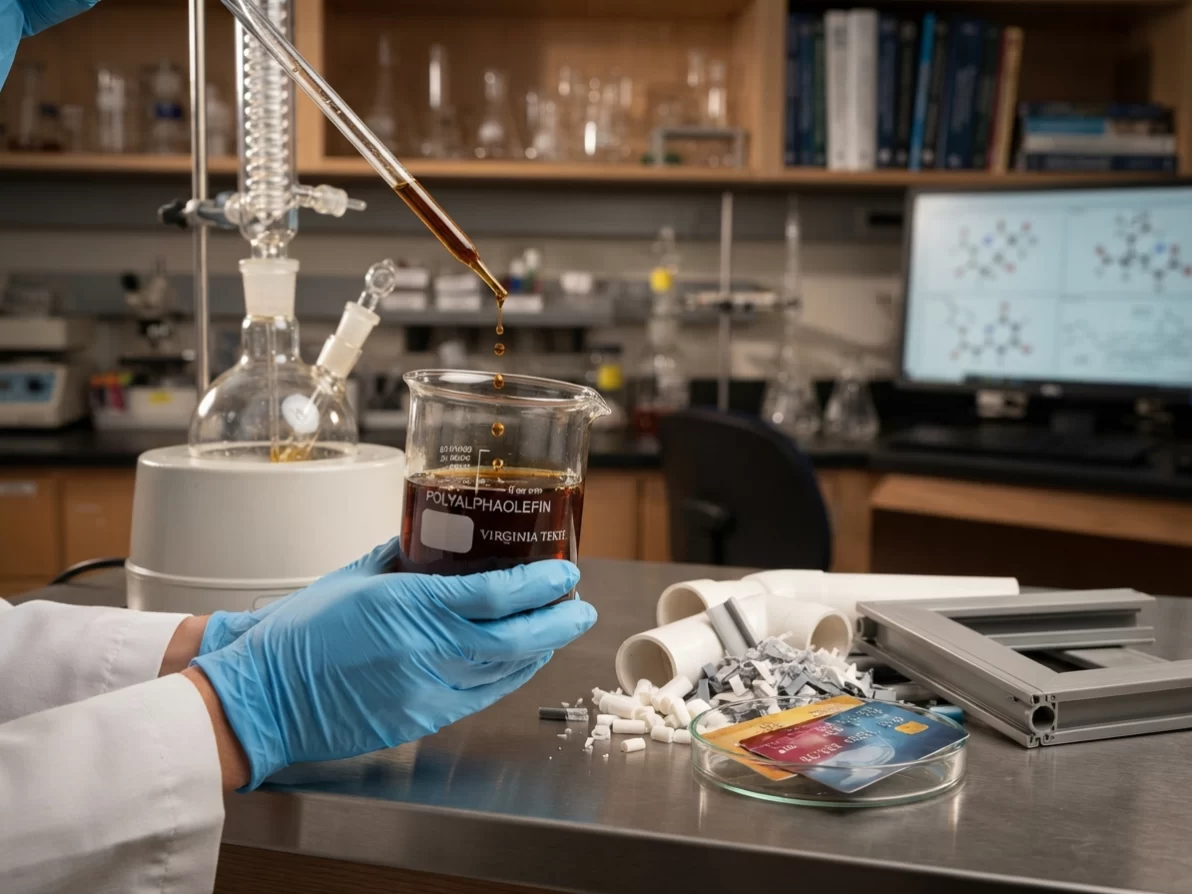
In the laboratory, the researchers submerge PVC sourced from credit cards, window frames, and household plumbing into a solvent. They add aluminum trichloride along with alpha-olefins, a class of hydrocarbons regularly used when formulating synthetic lubricants. When the mixture is heated to 158 degrees Fahrenheit for three hours, the reaction yields a thick lubricating oil.
The resulting polyalphaolefin belongs to a class of synthetic base oils favored for mechanical stability, broad operating temperature ranges, and effective friction reduction. Because engine lubricants lower wear and increase efficiency across equipment ranging from lawn mowers to passenger vehicles and jet engines, the process provides an alternative source while mitigating environmental waste.
From gooey polymers to molecular breakdown
This development follows earlier achievements from Liu’s laboratory, where other forms of plastic waste were successfully converted into surfactants used in detergents and soaps. Building on those findings, Liu set out to tackle PVC directly. “We want to help improve the recycling and upcycling of PVC,” Liu said, emphasizing an upcycling approach that generates products of higher value than the original scrap.
Liu assembled a graduate team consisting of Eric Munyaneza Nuwayo, who led the project during the final year of his doctoral program, Connor S. Thompson, and first-year student Abby Civiello. “I often called them the three musketeers,” Liu said of the student group.
Initially, the researchers attempted to modify the long polymer chains of PVC by substituting chlorine atoms with alternative chemical groups. “The idea was simple. PVC, as one of the most activated forms of polyethylene, ought to be easily converted into some other molecules by replacing the chlorine atoms with other groups,” Liu said. Those preliminary trials, however, yielded soft, sticky substances that lacked practical function.
A shift in perspective unlocked the breakthrough. “One day I realized — if this polymer is so gooey and so soft, why don’t I just keep breaking the polymer chains down to smaller segments?” said Liu. Breaking the molecular chains into smaller units produced the desired stable base oil.
Scaling the technology for broader use
To evaluate the real-world potential of the oil, the researchers collaborated across several institutions. Finished samples were tested by Ali Erdemir at Texas A&M University to measure lubricating performance, while William Goddard at Caltech supplied chemical computations to assess the fundamental chemistry. At Virginia Tech, Xi Chen formulated economic and manufacturing models to evaluate production on a wider scale.
Expanding the technique beyond the laboratory is the primary next step as the researchers aim to enhance the environmental sustainability of the system and broaden market access. “Lubricants are the silent hero out there. We often don’t recognize they exist, but they are out there working quietly. We want to be able to produce the oil on a larger scale to reach more people in the world,” Liu said.