

Key Takeaways
- Intersections with colorful pavement art and accompanying safety upgrades saw a 32% decline in car collisions and a 52% reduction in pedestrian and cyclist crashes.
- A study by TYLin and Bloomberg Philanthropies found average annual intersection crashes fell from 1.23 to 0.84, with injury crashes decreasing by 29%.
- Janette Sadik-Khan noted that “empirical evidence demonstrates its power to reshape public interaction,” as Bloomberg Philanthropies opens $100,000 grants for up to 10 eligible cities.
Visual street transformations link to sharper declines in traffic collisions
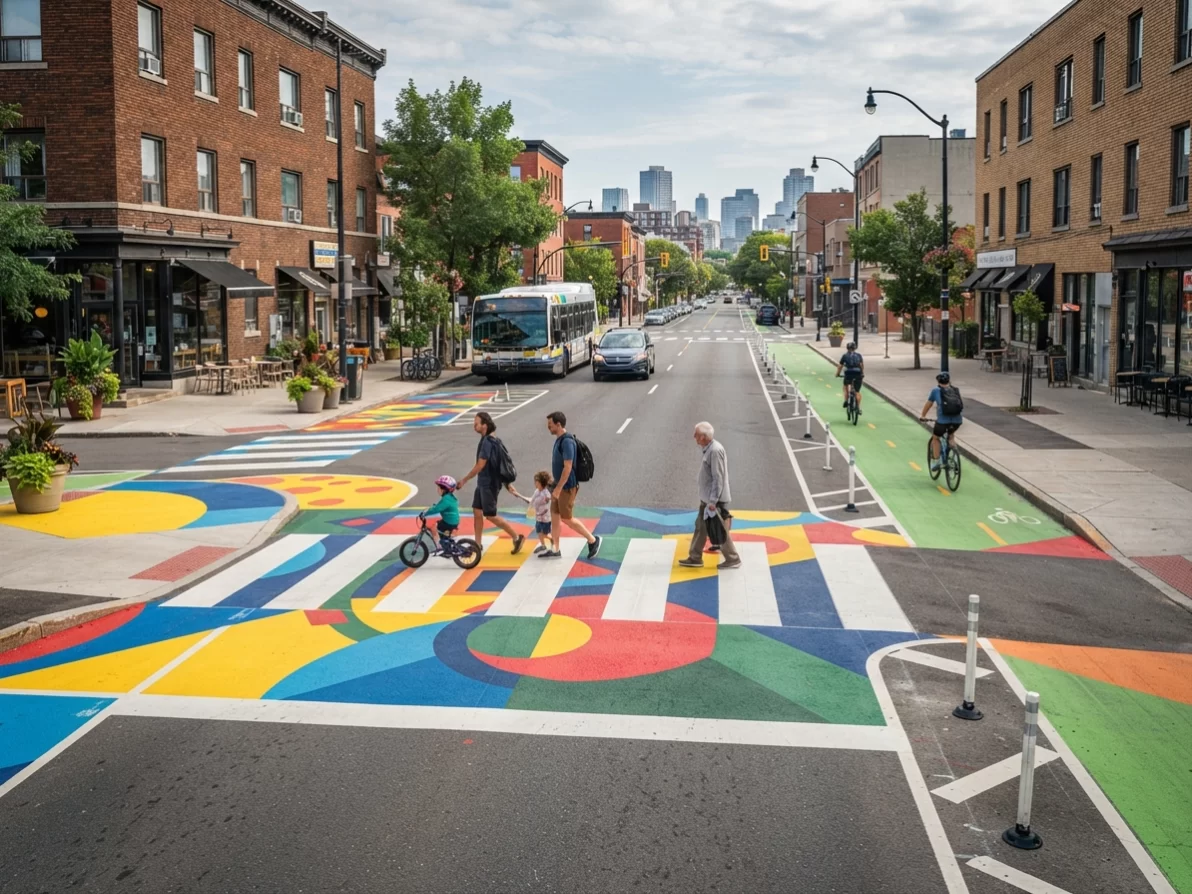
Vibrant roadway designs combined with targeted street redesigns are helping make urban intersections safer for pedestrians, cyclists, and motorists alike. Research examining intersections across the United States indicates that colorful pavement art paired with physical safety improvements leads to measurable reductions in dangerous driving behaviors and collisions.
A major analysis released on November 17 by Bloomberg Philanthropies and carried out by the engineering firm TYLin evaluated these intersections at double the scale of a previous 2022 review. The findings revealed that annual crashes at the average United States intersection dropped from 1.23 to 0.84 when asphalt artworks were installed. Furthermore, crashes resulting in injuries declined by 29%.
More broadly, intersections with colorful crosswalks or dedicated bike lanes recorded 32% fewer car collisions overall and a 52% drop in crashes involving pedestrians and bicyclists.
The combined power of design and art
Researchers note that artistic pavement projects rarely exist in isolation. Most initiatives pair artistic murals with functional street modifications such as painted curb extensions, high-visibility crosswalk markings, and flexible posts. These physical adjustments shorten pedestrian crossing distances, enhance sightlines, and encourage turning drivers to slow down.
Eric Hanns, senior associate and safe mobility lead at TYLin, explained the integrated approach to Engineering News-Record: “It’s not trying to isolate the effect of the art from the larger installation,” adding, “That’s just how these treatments are commonly deployed.”
Because these quick-build measures can be added within months, municipalities are able to test changes before undertaking capital-intensive infrastructure overhauls. Beyond the physical features, the artwork serves as a visual and psychological prompt that urges drivers to pay closer attention to their surroundings.
Shifting driver habits and neighborhood perceptions
Independent studies highlight noticeable shifts in driver compliance where artistic elements are added. In Washington, DC, a dedicated study revealed that 84% of approaching drivers yielded to pedestrians at curb extensions enhanced with mural art. In contrast, 62% yielded at temporary curb extensions without murals, and only 49% yielded at traditional intersections lacking extensions entirely.
A separate January 2026 study from the University of North Carolina similarly documented higher yielding rates at painted crossings. In Cincinnati, local reports noted a 300% surge in motorists coming to a complete halt at a designated artistic stop sign. In Durham, North Carolina, neighborhood sentiment changed dramatically after visual changes were implemented, with the share of people feeling unsafe while crossing the street dropping from 85% to just 6%.
Janette Sadik-Khan, Transportation Principal at Bloomberg Associates, emphasized the broader community impact of these interventions: “Street art does more than alter a roadway’s aesthetic—empirical evidence demonstrates its power to reshape public interaction,” she stated. “Extending our Asphalt Art Initiative throughout North, Central, and South American municipalities offers additional neighborhoods the opportunity to convert artistic vision and colorful paint into dynamic, secure thoroughfares.”
Expanding initiative opportunities across the Americas
Since its launch in 2019, the Asphalt Art Initiative has backed 100 separate projects across 97 cities in 20 nations. To expand the model further, Bloomberg Philanthropies launched a 2026–2027 funding round open to municipalities throughout North, Central, and South America, as well as the Caribbean. Up to 10 selected cities will each receive grants of up to $100,000 to implement their own creative street interventions.
While researchers emphasize that the current data reflects the impact of the entire package—including curb extensions and marked paths—rather than paint alone, transportation leaders appreciate that quick, low-cost artistic interventions can transform neighborhood safety for pennies on the dollar compared to full roadway reconstructions.