

Key Takeaways
- Researchers at the New Jersey Institute of Technology created the PHD-Hand, an open-source 3D-printed humanoid hand costing under $650 in components.
- The 15-degree-of-freedom device employs flexible TPU hinges and spring steel linkage rods instead of high-maintenance tendon cables.
- During roughly 200 hours of testing, the prototype performed fine-motor tasks and executed all 33 grasp types listed in the GRASP taxonomy.
New Jersey Institute of Technology researchers create low-cost dexterous robotic hand
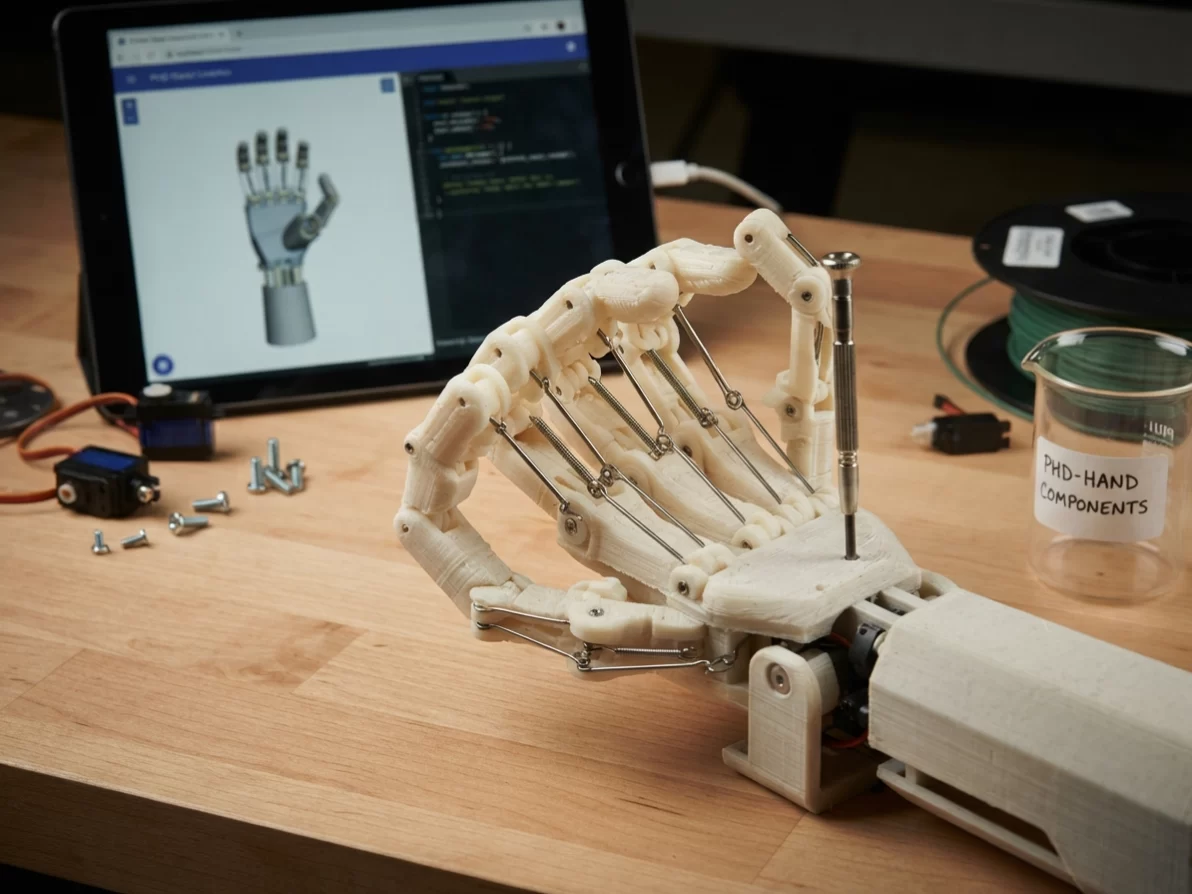
Engineering researchers at the New Jersey Institute of Technology have engineered an affordable, five-fingered humanoid robotic hand that can be manufactured using accessible 3D-printing equipment and readily available parts. Known as the Printable Humanoid Dexterous Hand, or PHD-Hand, the entire assembly requires less than $650 in components, presenting a viable alternative to complex and costly commercial systems.
Neel Adwani, Muhaiminul Islam Akash, Saffia Ouali, Ethan Liu and Cong Wang authored the study detailing the innovation, which has earned acceptance at the IEEE-RAS International Conference on Humanoid Robots (Humanoids 2026). Explaining the traditional hurdles in the field, Adwani, a PhD candidate at NJIT, noted that “Hands are still one of the hardest and most expensive parts of a humanoid to get right.”
Innovative linkage mechanism replaces fragile tendon cables
Unlike standard dexterous robotic hands that depend on tendon-driven systems, the PHD-Hand operates via a linkage-driven mechanism. This framework directly tackles longstanding complications involving mechanical complexity, high manufacturing budgets, reliability issues and frequent maintenance demands.
Highlighting the structural benefits of this engineering direction, Adwani explained: “PHD-Hand uses rigid linkage-driven fingers instead, a mechanism-design choice that delivers human-like dexterity without that maintenance.”
The physical structure spans a hand length of approximately 200 mm and features 15 total actuated degrees of freedom, allocating three actuated degrees of freedom across each of its five digits. Each digit contains 18 major components powered by generic miniature RC servos and regulated by a Pololu Mini Maestro 18 controller. At the foundation of every digit lies a 3D-printed flexible hinge fabricated from thermoplastic polyurethane (TPU). Paired with spring steel drive rods, these hinges generate smooth motion without demanding numerous miniature moving pieces. The drivetrain is fully linkage-driven, bidirectional and backdrivable in both directions, empowering the fingers to actively extend as well as contract.
Extensive testing confirms dexterity across everyday tasks
Throughout approximately 200 hours of prototype testing, the PHD-Hand exhibited wide functional versatility. The researchers successfully demonstrated all 33 grasp types categorized in the human GRASP taxonomy, though certain configurations remain imperfect.
Beyond standard holds, the prototype proved capable of handling complex fine-motor tasks. It rotated a 55 mm cube inside its palm, adjusted the position of a jar to remove its lid, operated a precision screwdriver and turned the worm screw on an adjustable wrench.
To coordinate these activities, the team utilized a browser-based control interface allowing operators to calibrate specific joints, activate predefined hand poses, and record or replay motion routines. The researchers employed Anthropic’s Claude AI system to formulate both the graphical control interface and the initial motion trajectories from text descriptions, later refining those movements on the physical hardware.
Open-source release expands access for innovators
To support broader engineering exploration, the team plans to publish the computer-aided design models, 3D-printing instructions, control software, motion sequences and the full bill of materials in an open-source GitHub repository.
Adwani emphasized the potential community impact of open access, stating: “Commercial humanoid hands often cost tens of thousands of dollars, so this lowers the barrier to entry for labs, startups and hobbyists.”
While additional testing remains essential to determine long-term durability and industrial capability, the project proves that creative mechanical design and inexpensive hardware can make advanced robotic manipulation accessible to developers everywhere.